
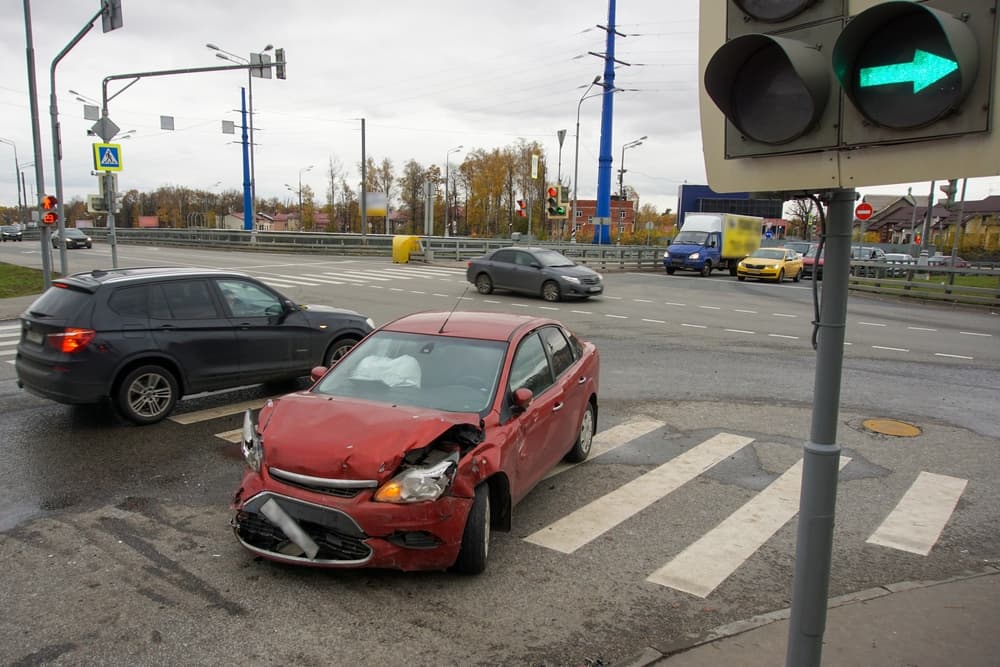
Morgantown may be a small city, but its traffic patterns tell a different story. With university traffic, local commuters, out-of-town visitors, and tight roads merging into major routes, certain intersections see far more accidents than others.
These areas often involve heavy congestion, confusing traffic flows, limited visibility, or drivers who are distracted or unfamiliar with the road layout. When collisions occur in these intersections, victims frequently suffer serious injuries and face uncertainty about what caused the crash and who is responsible.
Understanding which intersections pose the greatest risk helps residents stay alert — but after a crash occurs, legal support becomes essential. Robinette Legal Group, PLLC represents victims injured in these high-risk traffic zones and helps them navigate the complex claims that often follow.
Reach out to a Morgantown intersection accident lawyer at Robinette Legal Group, PLLC to investigate the crash and pursue the compensation you deserve—call today.
Key Takeaways:
- Several intersections in Morgantown consistently see higher crash rates.
- Heavy traffic, poor visibility, and driver error contribute to dangerous conditions.
- Intersection accidents often involve disputed liability and conflicting accounts.
- Victims may face long-term injuries requiring extensive documentation.
- Legal representation helps uncover what truly caused the collision.
Schedule a free case evaluation
Why Traffic Patterns Make Certain Morgantown Intersections More Dangerous
Morgantown’s layout includes narrow streets, steep grades, heavy student pedestrian flow, and intersections feeding into major roadways like University Avenue, Beechurst Avenue, Patteson Drive, and Van Voorhis Road. These features create frequent slowdowns and unpredictable driver behavior. Add in weather conditions, seasonal traffic from WVU events, and large numbers of out-of-town drivers, and intersections become hotspots for severe collisions.
At complicated intersections, drivers may misjudge gaps, accelerate too quickly, or fail to yield at crosswalks. Congestion also increases the likelihood of rear-end collisions, especially during morning and evening rush hours when drivers are in a hurry. Distracted driving plays a major role; even a moment of inattention can lead to a crash when multiple lanes merge or diverge.
These busy conditions mean that when a crash happens, victims often face a difficult process in determining who caused the accident. Insurance companies may blame weather, congestion, or even the victim to avoid responsibility. A thorough investigation is crucial, especially in intersections where crashes happen fast and visibility is limited.
University Avenue & Patteson Drive: A High-Risk Collision Zone
One of Morgantown’s busiest and most accident-prone intersections is University Avenue and Patteson Drive. This area handles constant traffic from WVU students, employees commuting to local hospitals, and visitors heading toward shopping centers and restaurants. The high volume of turning vehicles, sudden stops, and crosswalk activity significantly increases the risk of collisions.
Drivers traveling through this intersection must navigate short signal cycles, heavy pedestrian flow, and unpredictable lane changes. Many accidents here involve left-turn crashes, rear-end impacts, and side-impact collisions caused by drivers misjudging oncoming traffic or rushing to beat a changing light. Inclement weather — common during winter months — only makes the situation more dangerous.
When accidents happen at this intersection, victims often experience serious injuries due to the force of side or head-on impacts. Insurance companies may dispute fault, claiming the other driver had the right-of-way or that the victim misread the traffic signal. Robinette Legal Group analyzes video footage, police reports, and witness statements to determine exactly how the crash occurred.
Intersections like this require detailed investigation because of the many variables affecting responsibility.
Beechurst Avenue & Campus Drive: Heavy Pedestrian Activity Increases Risk
Beechurst Avenue and Campus Drive sit at the heart of student activity near the WVU campus. With thousands of students crossing daily, buses navigating tight corners, and drivers trying to merge quickly, this intersection frequently sees accidents involving both vehicles and pedestrians. The combination of high foot traffic and limited reaction time increases the risk of severe injuries.
Many crashes here occur when drivers fail to yield to pedestrians, rush through yellow lights, or become distracted by campus congestion. Students crossing between classes may also enter the intersection suddenly, catching drivers off guard. During peak hours, vehicles often back up into the intersection, creating confusion and leading to collisions.
Accidents at this location often involve significant impact, especially when drivers attempt to accelerate through a changing signal. Victims may suffer head injuries, fractures, or soft-tissue injuries requiring long-term treatment. In these cases, establishing liability can be difficult because multiple parties may provide conflicting accounts.
Robinette Legal Group examines every angle, including traffic flow, pedestrian timing, and roadway conditions, to determine how the collision occurred and who should be held accountable.
Van Voorhis Road Intersections: High Speeds Meet Heavy Congestion
Van Voorhis Road is known for its challenging traffic, especially near intersections with Burroughs Street, Willowdale Road, and Chestnut Ridge Road. These areas combine steep gradients, sharp curves, and high-speed travel with heavy congestion from medical facilities, campus traffic, and local business routes. Drivers unfamiliar with the area may brake abruptly or make unsafe turns, leading to multi-car collisions.
Crashes along Van Voorhis often involve chain reactions because drivers have limited visibility and little time to respond to sudden stops. Rear-end collisions, side impacts, and left-turn accidents are common, particularly during peak travel times. Nighttime conditions further reduce visibility, increasing the risk for drivers, pedestrians, and cyclists.
Victims injured in collisions along Van Voorhis Road often face significant medical needs, and their claims require strong evidence due to the complex traffic patterns involved. Insurance companies may argue that road design or weather played a role, attempting to reduce the driver’s liability. Our firm gathers the evidence needed to counter these arguments and highlight the true cause of the crash.
These intersections demonstrate how quickly a dangerous situation can develop — and how important strong legal support becomes afterward.
US-119 & Willowdale Road: A Complicated Intersection for Out-of-Town Drivers
The intersection at US-119 and Willowdale Road is especially challenging for out-of-town drivers traveling to Ruby Memorial Hospital, WVU Medicine Children’s, or Mountaineer Field. With multiple turn lanes, fast-moving traffic, and inconsistent driver familiarity with the area, accidents here occur frequently. Collisions often involve misjudged lane changes, sudden merging, or confusion about yielding rules.
During game days or large regional events, traffic becomes even more unpredictable. Visitors unfamiliar with Morgantown’s roadways may stop suddenly, attempt last-minute turns, or merge aggressively, causing serious collisions. Many victims suffer injuries that require long-term medical care or ongoing physical therapy.
Fault at this intersection is often heavily contested. Drivers may give contradictory statements, and insurance companies quickly point fingers to limit their exposure. Robinette Legal Group uses crash reconstruction techniques, roadway evaluations, and witness interviews to clarify how the collision happened.
Because this intersection handles such a large volume of traffic — both local and out-of-state — a detailed and methodical legal approach is essential when injuries occur here.
How Local Traffic Patterns Contribute to Intersection Crashes
Morgantown’s traffic patterns are shaped by its university population, hilly terrain, narrow streets, and mix of residential and commercial zones. During the school year, intersections experience surges in traffic at class change times, leading to congestion and unpredictable driver behavior. Drivers may stop short, accelerate suddenly, or block intersections because they misjudge how far traffic will move.
These patterns create a perfect environment for collisions, especially when multiple lanes converge or when visibility is limited.
Seasonal changes also influence traffic behavior. During winter, icy roads on inclines make it difficult for vehicles to stop safely at intersections. In the summer, construction projects near main corridors like University Avenue or Patteson Drive narrow lanes and confuse drivers unfamiliar with detours. All of these conditions increase the likelihood of rear-end crashes, side impacts, and pedestrian accidents.
Insurance companies may claim that these environmental factors — not their driver — caused the collision. But roadway conditions rarely excuse negligence. Our firm evaluates how the driver responded to traffic flow, whether they adjusted their speed safely, and whether they were attentive to changes in congestion. Understanding local traffic behavior is essential for building strong cases and ensuring victims aren’t unfairly blamed for circumstances beyond their control.
Schedule a free case evaluation
Why Dangerous Intersections Create Complex Liability Disputes
Accidents at high-risk intersections often involve multiple vehicles, conflicting driver statements, and unclear right-of-way. Even a simple left-turn collision can become complicated if signals were obstructed, timing was questioned, or a driver accelerated through a yellow light. Insurance companies try to use this confusion to their advantage, arguing that victims contributed to the crash or misinterpreted traffic signals.
Liability becomes even more complex when pedestrians, cyclists, buses, or out-of-town drivers are involved. A single moment of distraction or misjudgment can create a chain-reaction collision, leaving investigators with multiple points of impact and differing accounts of what happened. In Morgantown’s busiest intersections, these disputes are common, and insurers may use the lack of clarity to undervalue or deny claims.
Robinette Legal Group approaches these cases with detailed evidence gathering. We look for nearby cameras, analyze crash mechanics, review cell-phone data when necessary, and reconstruct the scene to determine who acted negligently. Establishing liability is not just about identifying the driver at fault — it’s about proving how their actions led to the crash, despite confusing or fast-changing conditions.
Clear, well-supported analysis helps ensure victims are compensated fairly for injuries caused by someone else’s mistake.
Common Injuries Seen in Intersection Collisions
Intersection accidents often happen at higher speeds or involve side-impact collisions, which expose drivers and passengers to more severe injuries. Victims commonly suffer fractures, concussions, whiplash, spinal injuries, shoulder damage, or traumatic brain injuries. The sudden rotational forces in these crashes can also cause soft-tissue injuries that limit mobility and require months of rehabilitation.
Pedestrians and cyclists are especially vulnerable at Morgantown intersections, where vehicle speeds and close proximity to traffic can lead to devastating harm. These injuries often require extensive medical treatment, follow-up care, and long-term physical therapy. Even injuries that appear minor at first — like neck pain or dizziness — can worsen over time, impacting work, school, and daily activities.
Insurance companies may argue that these injuries are exaggerated or unrelated, especially if the victim did not receive emergency care immediately. Our firm ensures injuries are fully documented, including changes in mobility, ongoing pain, and how the injuries affect your ability to work or care for your family. Intersection crashes frequently change the trajectory of a victim’s life, and your legal claim should reflect the full impact of the harm you suffered.
How Evidence Is Preserved After an Intersection Crash
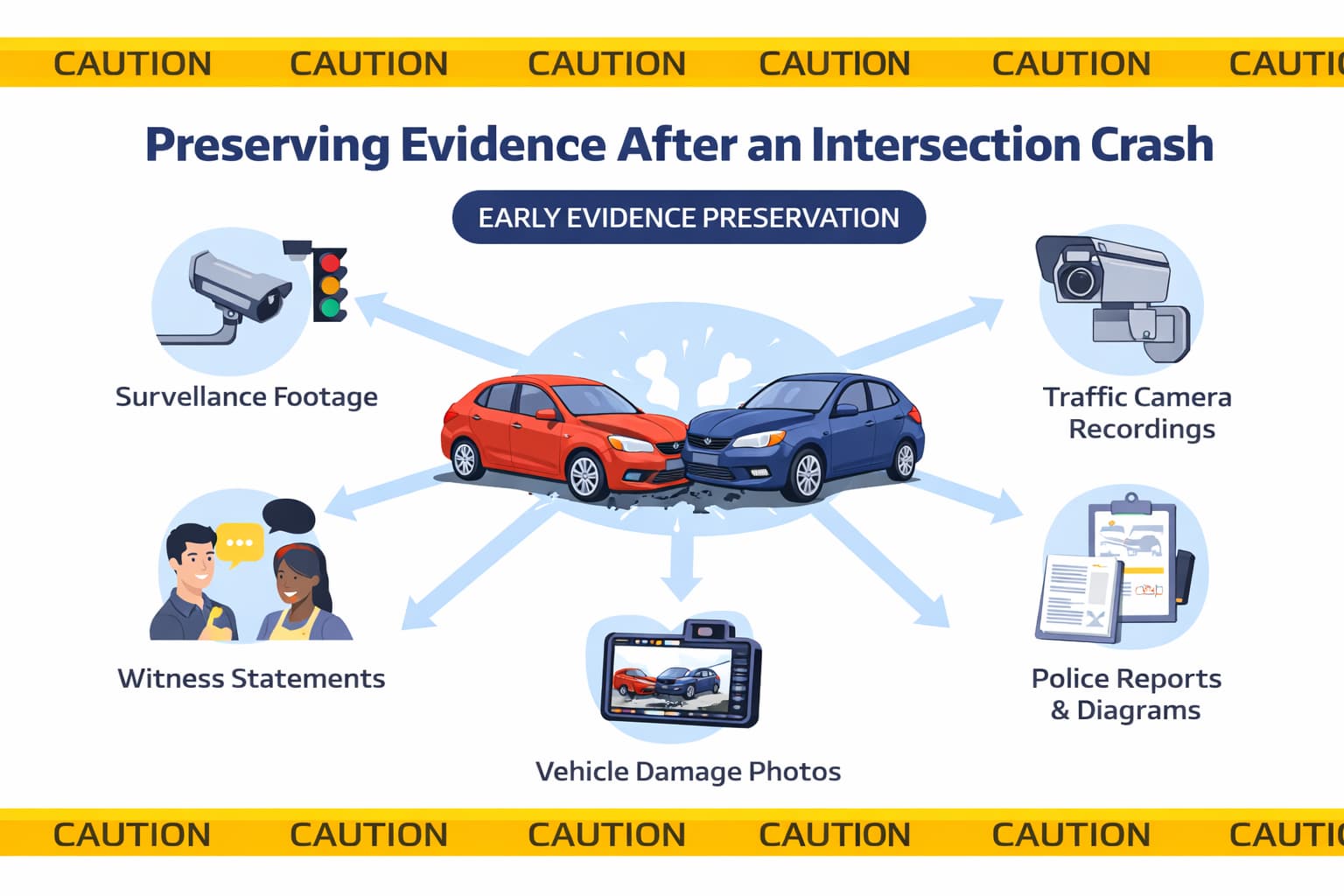
Evidence at an intersection crash scene disappears quickly. Vehicles are moved, debris is cleared, signals reset, and witnesses leave within minutes. For victims, this creates challenges because insurers may later dispute how the collision occurred or claim there is not enough information to support liability. Preserving evidence early makes a significant difference in the strength of a claim.
Robinette Legal Group acts fast to secure evidence before it’s lost. We request nearby surveillance footage, look for traffic camera recordings, collect witness statements, and photograph vehicle damage patterns. We also obtain police reports, roadway diagrams, and any available electronic vehicle data. In serious cases, crash reconstruction experts help analyze speed, braking, and angle of impact.
Time matters because insurers may begin shaping their defense immediately, even before victims have recovered enough to understand what happened. Early evidence preservation ensures the truth is documented clearly and keeps insurers from rewriting the story. This proactive approach is one of the most important protections available to victims of intersection accidents.
Why Victims Should Seek Legal Help After an Intersection Accident
Victims often struggle with medical appointments, missed work, and emotional stress after an intersection crash. Navigating insurance claims on top of those challenges can be overwhelming. Insurers may request statements, push for early settlements, or argue that victims share responsibility — all strategies designed to reduce what they must pay. Without legal support, victims may unknowingly accept less than they deserve or lose important evidence needed for their case.
Robinette Legal Group ensures victims are not taken advantage of during this vulnerable time. We manage communication with insurers, preserve evidence, coordinate with medical providers, and build a detailed account of how the accident has affected your life. Our attorneys understand how disputed liability, confusing traffic patterns, and complex injuries intersect in these cases.
Having an experienced legal advocate increases your chances of receiving full compensation for medical costs, lost wages, future care, and pain and suffering. Intersection accidents create legal challenges that victims should not face alone — having the right representation can make all the difference.
Give Us a Call Today
Intersection accidents leave victims dealing with pain, uncertainty, and complicated insurance disputes. You deserve a firm that understands how to investigate these challenging cases, protect your rights, and pursue full compensation for your injuries. Robinette Legal Group, PLLC is ready to guide you through the process with experience and care.
If you were injured in an intersection crash in Morgantown or a nearby community, give us a call today at (304) 594-1800 to speak with a dedicated Morgantown personal injury lawyer who can help.
Schedule a free case evaluation
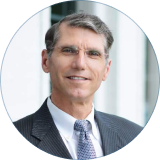
Jeffery Robinette was admitted to practice law in 1991 and is licensed in all levels of state and federal trial courts in West Virginia. Mr. Robinette is also licensed in all state and federal appeals courts in West Virginia and the United States Supreme Court. As a National Board Certified Trial Attorney who has handled hundreds of motor vehicle, injury, and construction defect claims and a leading author on insurance claims settlement issues and difficulties in West Virginia, Jeff Robinette is uniquely qualified to represent your best interest.