
Understanding West Virginia’s Pre-Suit Hurdle in Medical Negligence Claims
Key Takeaways: A screening certificate of merit is a sworn document from a qualified health care provider required under West Virginia’s Medical Professional Liability Act (W. Va. Code §55-7B-6) before filing most medical malpractice lawsuits. It confirms a legitimate basis exists for a negligence claim and must address five specific elements: the standard of care, how it was breached, and how that breach caused injury. The signing provider must devote at least 60% of professional time to clinical practice or teaching in the relevant field and have no financial interest in the claim. A separate certificate is required for each provider sued. Limited exceptions allow a statement of basis of liability when no expert testimony is needed, or a statement of intent to provide the certificate later when deadlines loom. These pre-suit rules run alongside strict filing deadlines, generally two years, with special timelines for minors and nursing home claims, capped by a 10-year outer limit.
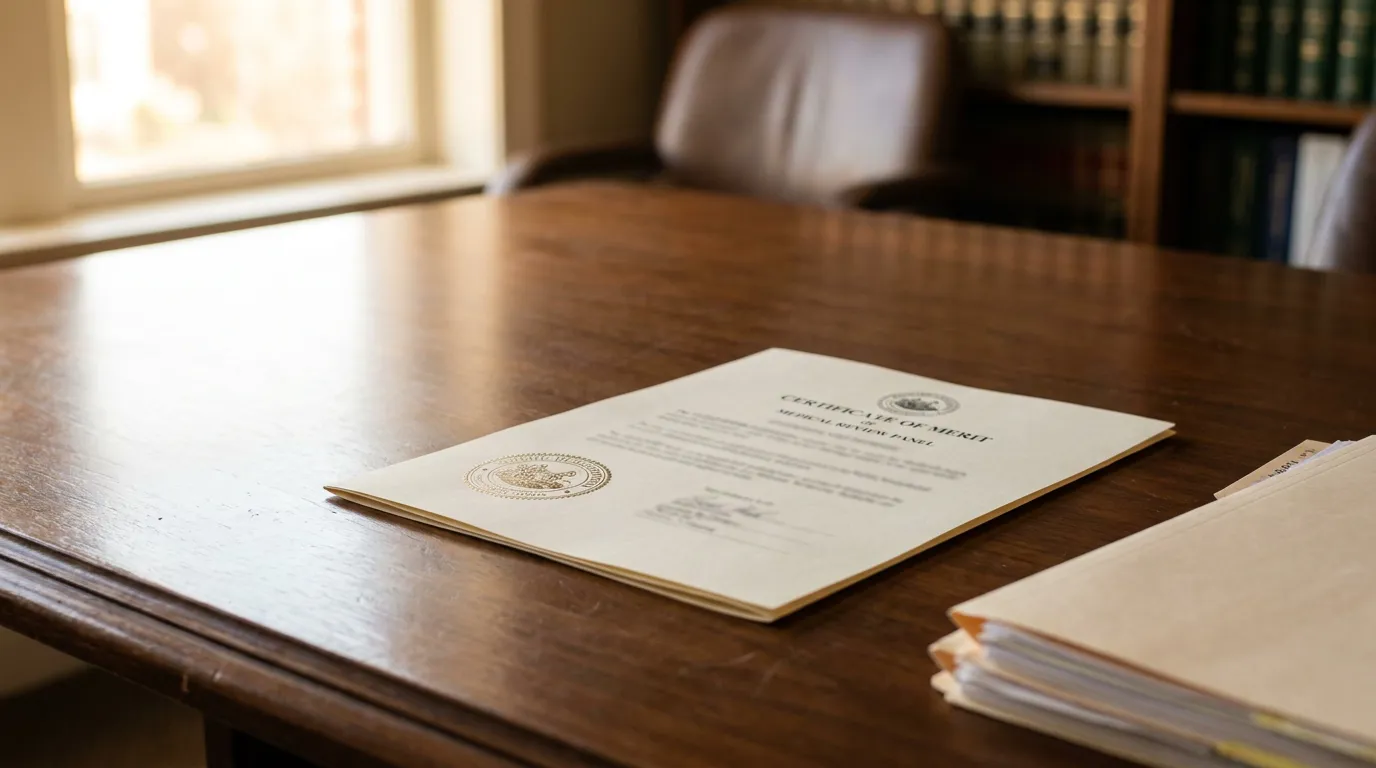
A screening certificate of merit is a sworn document from a qualified health care provider that must accompany your notice of claim before you can file most medical malpractice lawsuits in West Virginia. It confirms that a legitimate basis exists to pursue a claim of medical negligence. For victims who have suffered harm such as a birth injury, surgical error, or missed diagnosis, this requirement is one of the first critical steps toward accountability and compensation.
If you or a loved one suffered serious injury because of suspected medical negligence, the team at Robinette Legal Group PLLC is ready to help. Call our office at 304-501-5753 or reach out through our secure contact page to discuss how the certificate of merit process applies to your situation.

What the Screening Certificate of Merit Actually Requires
The screening certificate of merit is governed by West Virginia’s Medical Professional Liability Act, specifically W. Va. Code §55-7B-6. Under §55-7B-6(b), at least 30 days prior to filing a medical professional liability action, the claimant must serve a notice of claim on each health care provider by certified mail with the certificate. This pre-suit step is designed to weed out unsupported claims while protecting the rights of genuinely injured patients.
The certificate must be executed under oath by a qualified health care provider. That provider must qualify as an expert under the West Virginia Rules of Evidence, meet the requirements of §55-7B-7(a)(5) and (a)(6), and have devoted at least 60% of professional time annually to active clinical practice or teaching in the relevant medical field. You can review the full statutory text through the official Justia listing of §55-7B-6.
💡 Pro Tip: Keep a complete, organized copy of every medical record, bill, and discharge instruction. The reviewing provider must list all records examined, so thorough documentation strengthens the certificate from the start.
The Five Elements Every Certificate Must Address
Under §55-7B-6(b), the certificate must state with particularity five specific elements that give the defendant fair notice of the theory of liability:
- The basis for the provider’s familiarity with the applicable standard of care at issue
- The provider’s qualifications
- The provider’s opinion as to how the standard of care was breached
- The provider’s opinion as to how the breach resulted in injury or death
- A list of all medical records and other information reviewed
A separate certificate is required for each health care provider you intend to sue. Section §55-7B-6(b) requires a separate screening certificate of merit for each provider against whom a claim is asserted. The signing provider must have no financial interest in the claim, though that provider may later serve as an expert witness.
How a Morgantown Medical Malpractice Lawyer Approaches the Certificate
A Morgantown medical malpractice lawyer generally begins by securing a thorough review of the records by a qualified provider in the appropriate field. Because the certificate hinges on proving duty, breach of the standard of care, and causation, the strength of that underlying opinion shapes the entire case. Learn more about the role of expert witnesses in WV injury cases and why their testimony often determines outcomes.
Identifying the correct field of practice for the reviewing provider is critical. A claim involving an anesthesia error generally calls for a provider with relevant anesthesiology background, while a retained surgical instrument may call for a surgeon. Courts scrutinize whether the signing provider truly meets the 60% clinical or teaching threshold.
💡 Pro Tip: Do not wait until the filing deadline approaches to seek a record review. Qualified providers need time to evaluate complex records, and rushing the process can compromise the particularity the statute demands.
Exceptions and Alternatives to the Standard Certificate
Not every claim requires a full screening certificate of merit at the outset. West Virginia law builds in limited flexibility for certain situations, though these exceptions are narrowly interpreted.
Under §55-7B-6(c), a claimant who believes no certificate is necessary may file a statement of the basis of liability instead. This applies only when the cause of action rests on a well-established legal theory that does not require expert testimony to support a breach of the standard of care. A classic example might be an instrument left inside a patient after surgery.
When the statute of limitations is about to expire, §55-7B-6(d)-(e) allows a statement of intent to provide the certificate later. In general cases, the claimant may furnish the certificate within 60 days, while claims involving nursing homes or assisted living facilities allow up to 120 days. This mechanism can preserve a claim, but the certificate must still ultimately satisfy every statutory element.
💡 Pro Tip: Treat any extension provision as a safety net, not a strategy. Deadlines in malpractice claim filing in WV are strict, and relying on extensions can create avoidable risk.
Deadlines That Shape Your Right to File
West Virginia’s filing deadlines run alongside the certificate requirement, and missing them can permanently bar a claim. The statute of limitations defines how long an injured patient has to bring suit.
Most medical malpractice claims must be commenced within two years under W. Va. Code §55-7B-4(a). That two-year window generally runs from the date of injury or death, or from the date the person discovers or reasonably should have discovered the medical injury. The statute imposes an absolute outer limit of 10 years from the date of medical injury. You can read the deadline provisions directly in the West Virginia Code §55-7B-4.
Special timing rules apply to minors and to nursing home claims. For a minor under age 10 at the time of injury, §55-7B-4(c) provides that the action must be commenced within two years of the injury or before the minor’s 12th birthday, whichever provides the longer period. Claims against nursing homes and assisted living facilities carry a one-year limitation under §55-7B-4(b).
| Claim Type | General Limitation Period | Statutory Source |
|---|---|---|
| Most health care providers | Two years from injury or discovery | §55-7B-4(a) |
| Minor under age 10 | Two years, or until the 12th birthday, whichever is longer | §55-7B-4(c) |
| Nursing home or assisted living | One year from injury or discovery | §55-7B-4(b) |
| Absolute outer limit | 10 years from date of medical injury | §55-7B-4(a) |
Why These Requirements Matter for Serious Injury Victims
For victims of significant medical negligence in West Virginia, the certificate of merit is the gateway to recovering meaningful compensation. Life-altering injuries often bring substantial healthcare costs, including emergency care, surgery, rehabilitation, and ongoing treatment that can stretch for years.
The full scope of recoverable damages frequently extends beyond medical bills. Many victims face lost wages and diminished earning capacity, along with profound pain, emotional distress, and lasting impact on quality of life. Under §55-7B-8 West Virginia caps noneconomic damages such as pain and suffering, while economic damages remain uncapped. You can explore the firm’s approach to medical malpractice Morgantown WV cases for more detail.
💡 Pro Tip: Start a journal documenting how the injury affects daily life, work, and relationships. This contemporaneous record can powerfully support non-economic damages later in the case.
Frequently Asked Questions
1. Who can sign a screening certificate of merit in West Virginia?
A qualified health care provider must sign it. Under §55-7B-6(b), that provider must qualify as an expert under the Rules of Evidence, meet §55-7B-7(a)(5) and (a)(6), and have devoted at least 60% of professional time annually to active clinical practice or teaching in the relevant field.
2. Do I need a separate certificate for the hospital and the doctor?
Generally, yes. Section §55-7B-6(b) requires a separate screening certificate of merit for each health care provider against whom a claim is asserted. The signing provider must have no financial interest in the claim but may later serve as an expert witness.
3. What happens if my filing deadline is about to expire?
You may be able to file a statement of intent to provide the certificate later. Under §55-7B-6(d)-(e), claimants generally have 60 days to furnish the certificate, or 120 days in nursing home cases. This option preserves the claim but does not eliminate the certificate requirement.
4. Can a case proceed without a certificate of merit at all?
In limited circumstances, yes. Under §55-7B-6(c), if the claim rests on a well-established legal theory that does not require expert testimony, a statement of the basis of liability may be filed instead. Courts apply this exception cautiously.
5. How long do I have to file a medical malpractice claim?
Most claims must be filed within two years under §55-7B-4(a), subject to a 10-year outer limit. Minors and nursing home claims follow different timelines, and discovery or tolling provisions are interpreted narrowly.
Protecting Your Claim From the Very First Step
The screening certificate of merit is more than a procedural formality; it is a foundational requirement that can determine whether a serious medical negligence claim moves forward. From identifying the right reviewing provider to satisfying the five statutory elements and meeting strict filing deadlines, each step carries real consequences for injured victims and their families.
If you believe you or a loved one suffered harm from medical negligence in West Virginia, do not wait to seek guidance. Contact Robinette Legal Group PLLC today by calling 304-501-5753 or reaching out through our online case review form to discuss how an experienced Morgantown medical malpractice lawyer can help you understand your rights and pursue the recovery you deserve.

Jeffery Robinette was admitted to practice law in 1991 and is licensed in all levels of state and federal trial courts in West Virginia. Mr. Robinette is also licensed in all state and federal appeals courts in West Virginia and the United States Supreme Court. As a National Board Certified Trial Attorney who has handled hundreds of motor vehicle, injury, and construction defect claims and a leading author on insurance claims settlement issues and difficulties in West Virginia, Jeff Robinette is uniquely qualified to represent your best interest.