

Personal injury cases in West Virginia often involve complex questions about how an accident occurred, what injuries resulted, and how those injuries affect a victim’s life. While evidence like photos, medical records, and police reports plays an important role, many cases require deeper analysis that goes beyond what the average person can interpret.
This is where expert witnesses become essential. Their professional training allows them to explain technical issues, clarify disputed facts, and present information that juries and insurance companies rely on to understand what truly happened.
Expert witnesses help level the playing field for injured victims, especially when insurance companies hire their own specialists to challenge claims. Their insight can strengthen a case significantly by providing objective, credible explanations supported by science and professional experience.
Reach out to a West Virginia personal injury lawyer who knows how to use expert witnesses to strengthen your claim—contact us today.
Key Takeaways:
- Expert witnesses clarify complex issues in personal injury cases.
- Their testimony helps establish liability, injury severity, and long-term impact.
- Experts make technical information easier for juries and insurers to understand.
- They help counter insurance company arguments and hire defense experts.
- Strong expert support often increases the strength and value of a claim.
Schedule a free case evaluation
Why Expert Witnesses Matter in West Virginia Personal Injury Claims
Expert witnesses play a crucial role when a case involves technical or disputed facts. Insurance companies often challenge how an accident occurred, question the seriousness of injuries, or argue that a victim’s symptoms existed before the incident. Without expert insight, these arguments can weaken a case and create confusion about what is accurate. Experts provide clarity by examining evidence and offering professional opinions grounded in training and experience.
Their testimony carries significant weight because they are not just giving an opinion — they are interpreting facts through the lens of specialized knowledge. Whether the case involves a car crash, a fall, a workplace injury, or a traumatic brain injury, experts help connect the dots by explaining mechanisms of injury, accident dynamics, and long-term medical consequences.
Strong expert involvement also counters the strategies insurers use to dispute claims. When an insurance company brings in its own specialists to minimize injuries or blame the victim, your expert testimony provides a powerful rebuttal supported by data and analysis. The ability to explain complex issues in straightforward, credible terms often becomes a deciding factor in negotiations and trial outcomes.
Types of Expert Witnesses Commonly Used in Personal Injury Cases
Different types of experts may be involved depending on the nature of the injury and the circumstances of the accident. Medical experts are among the most important because they diagnose injuries, explain treatment plans, and describe long-term effects.
Specialists such as neurologists, orthopedic surgeons, and physical rehabilitation physicians can clarify how injuries impact daily life and future abilities. Their testimony helps show that the victim’s pain, limitations, and medical needs are real and directly related to the accident.
Accident reconstruction experts also play a significant role, especially in vehicle collisions or complex impact events. They use measurements, physics, and crash data to explain how the accident occurred, who likely caused it, and whether the impact could have produced the injuries reported. Their analysis is essential when drivers offer conflicting accounts or when insurers argue that the crash could not have caused the reported harm.
Other experts may include economic professionals who assess lost wages and future earning capacity, engineers who evaluate structural or mechanical failures, and vocational experts who explain how injuries affect someone’s ability to work. Each expert contributes a piece of the puzzle, giving the case a clear and comprehensive foundation.
How Expert Witnesses Strengthen the Medical Side of a Claim
Medical testimony is often the backbone of a personal injury case because it proves the nature and extent of the injuries. Insurance companies frequently challenge whether the victim’s injuries were caused by the incident or whether they were pre-existing. Medical experts can explain the difference, showing how trauma from the accident aggravated or worsened any prior conditions. Their documentation and testimony help establish a clear timeline of injury and recovery.
An expert’s explanation of medical records, imaging studies, and treatment needs also influences how insurers and juries view the severity of the injuries. Complex medical issues — such as traumatic brain injuries, spinal damage, nerve injuries, or chronic pain conditions — require specialized interpretation. Without expert insight, these injuries may be misunderstood or minimized.
Medical experts also help predict long-term consequences, including future surgeries, therapy needs, or permanent disability. This information is essential for calculating compensation, ensuring that victims receive support not just for immediate medical bills but for ongoing care. Their involvement gives the case credibility and creates a complete picture of the victim’s physical recovery.
Using Accident Reconstruction Experts to Establish Fault
When liability is disputed, accident reconstruction experts provide crucial clarity. They analyze skid marks, vehicle damage, roadway conditions, and crash data to determine how the collision unfolded. Their findings help explain whether a driver was speeding, failed to yield, braked suddenly, or made an improper maneuver. This is especially important in cases where drivers blame each other or where the police report is incomplete.
Accident reconstruction experts can also evaluate physical evidence from the scene, including camera footage, debris patterns, and measurements taken by responding officers. Their analysis often reveals details that are not immediately obvious, such as the angle of impact or the speed at which the vehicles were traveling. These details can be the deciding factor in proving responsibility.
Insurance companies rely on their own experts to dispute liability, but a credible reconstruction specialist counters these claims by presenting scientifically supported conclusions. Their testimony provides a strong foundation for establishing fault, helping victims pursue compensation with confidence.
How Financial and Economic Experts Strengthen Compensation Claims
In many personal injury cases, one of the biggest challenges is proving the financial impact of the accident. Medical bills and property damage are straightforward, but long-term losses — such as reduced earning capacity, diminished work opportunities, or the need for future medical care — require specialized analysis. This is where financial and economic experts become essential.
These professionals evaluate a victim’s career path, work history, educational background, and medical limitations to estimate how the injury will affect lifetime earnings. Their calculations often include lost wages, missed promotions, reduced work hours, inability to return to the same job, or early retirement due to disability. Without this expert insight, insurance companies might argue that a victim can simply return to work or that their earning potential remains unaffected.
Economic experts also help quantify future medical expenses, rehabilitation needs, and the financial burden of long-term disability. Their testimony gives juries and insurance adjusters a clear understanding of what the victim will face in the years ahead. These detailed projections add credibility and fairness to compensation claims, ensuring victims are not left covering costs that should fall on the at-fault party.
Schedule a free case evaluation
Vocational Experts and Their Impact on Disability Assessments
Vocational experts play a key role in determining how an injury affects a victim’s ability to work. They analyze job requirements, physical limitations, and employment opportunities to determine whether the victim can return to their previous role or transition into a different position. Their assessments are particularly important in cases involving spinal injuries, traumatic brain injuries, chronic pain, or significant mobility restrictions.
Insurance companies often claim that injured individuals can still work or find alternative employment.
A vocational expert challenges these assumptions by explaining how specific limitations — such as difficulty lifting, standing, concentrating, or sitting for long periods — affect job performance. They compare the victim’s abilities before and after the accident, highlighting the real-world obstacles that employers and job markets present.
These experts also help quantify lost earning capacity by providing insight into what types of jobs remain available and whether those positions offer comparable pay. Their testimony provides vital context that purely medical evidence cannot convey. When combined with economic expert findings, vocational analysis helps build a complete, accurate picture of the victim’s financial future.
Engineering and Technical Experts in Premises and Product-Related Claims
In cases involving structural failures, unsafe premises, or defective equipment, engineering and technical experts offer crucial insight. They evaluate whether a property owner followed safety standards, whether a building component failed unexpectedly, or whether equipment was designed or maintained properly. Their findings help determine whether negligence played a role in the accident.
For example, in a slip-and-fall case, an engineering expert might analyze flooring materials, lighting conditions, and building codes to identify safety violations. In equipment-related injuries, they may examine mechanical components, design flaws, or maintenance records. These conclusions can significantly strengthen liability claims by providing objective, science-based explanations for how and why the incident occurred.
Insurance companies often try to deny negligence by blaming the victim or suggesting the hazard was unforeseeable. Technical experts counter these claims by showing clear evidence of unsafe conditions, improper procedures, or preventable equipment failures. Their testimony provides a foundation for establishing responsibility and ensures victims receive fair consideration.
How Expert Testimony Impacts Settlement Negotiations and Trials
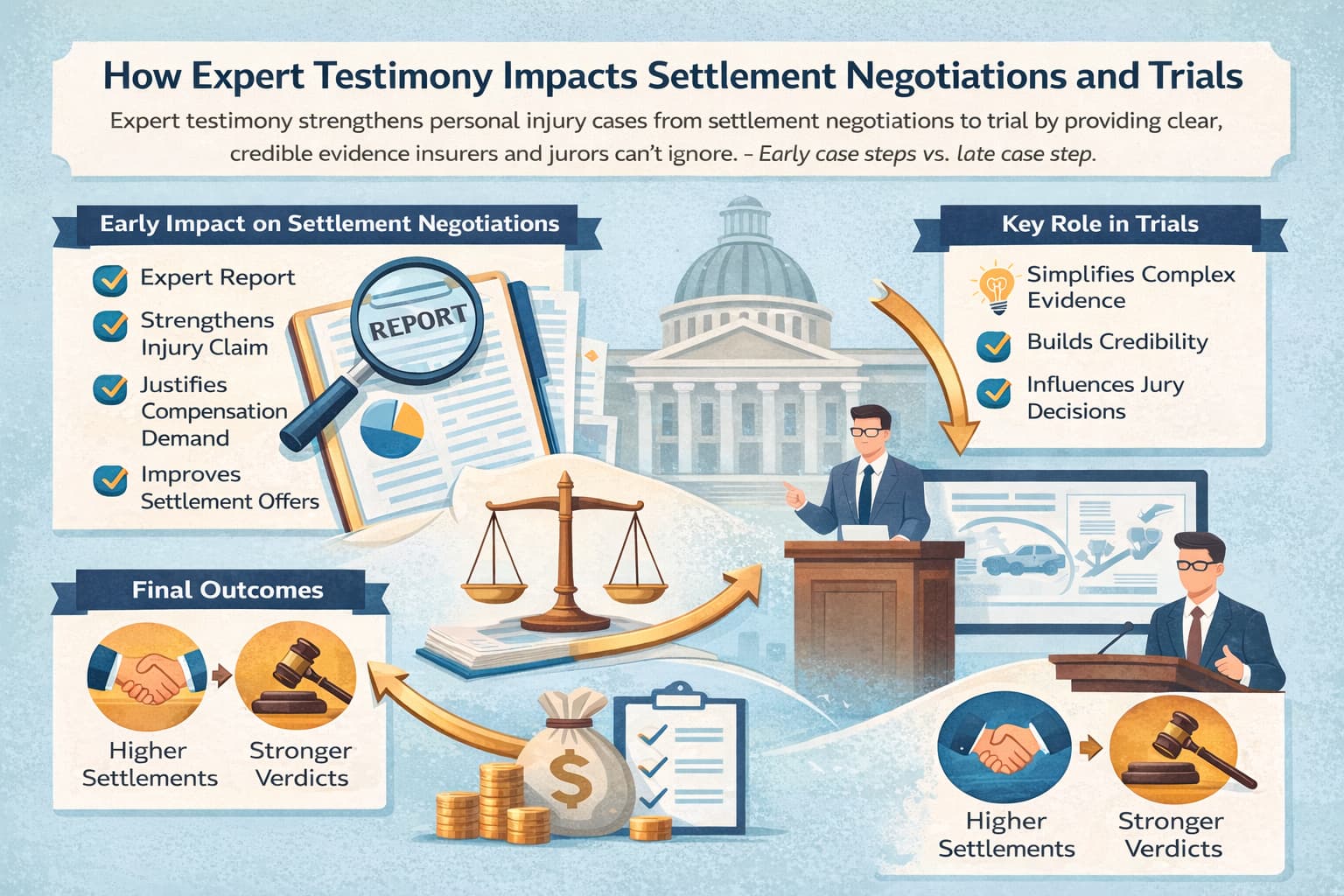
Expert testimony often shapes the trajectory of a personal injury case long before it reaches a courtroom. During settlement negotiations, experts provide the evidence insurance companies need to see to take a victim’s injuries seriously. Their reports, opinions, and projections help justify compensation demands and demonstrate the strength of the claim.
Insurance adjusters rely heavily on expert assessments to evaluate risk. When a victim’s case includes strong expert support, insurers are more likely to negotiate fairly and avoid trial. Conversely, when cases lack expert input, insurers may assume the claim is weak or incomplete, offering lower settlements.
If a case goes to trial, expert witnesses play a key role in helping jurors understand complex material. They translate technical information into clear, accessible explanations that connect the facts of the case with the harm the victim suffered. Their credibility and clarity often influence juror decision-making more than lay testimony alone. In many cases, expert testimony becomes the deciding factor in achieving a favorable verdict.
Why Personal Injury Victims Benefit from Early Expert Involvement
The sooner experts are involved in a personal injury case, the better the outcome typically is.
Early involvement allows accident reconstruction professionals to examine the scene before evidence disappears, gives medical experts time to evaluate injuries thoroughly, and helps financial experts begin documenting lost wages and future expenses. Delays can lead to missing records, fading memories, or incomplete documentation — all of which weaken a victim’s claim.
Insurance companies do not wait to build their case. They often hire experts immediately to look for ways to minimize liability or blame the victim. By involving experts early, victims ensure they have equal access to specialized knowledge and objective analysis. This proactive approach protects their rights and increases the likelihood of a full and fair recovery.
Robinette Legal Group coordinates expert involvement at the right stages of the case to support every aspect of the claim. From accident reconstruction to medical evaluations and long-term financial assessments, expert insight strengthens the case and provides the depth and clarity needed to secure fair compensation.
Give Us a Call Today
Expert witnesses can make a significant difference in the strength and success of a personal injury claim. Their insight brings clarity to complex issues, counters insurance company tactics, and supports the full value of the victim’s losses. Robinette Legal Group, PLLC has the experience and resources to bring in the right experts at the right time, ensuring your case is supported by strong, credible analysis.
If you or a loved one was injured and needs experienced guidance, give us a call today at (304) 594-1800 to speak with an attorney who can help.
Schedule a free case evaluation

Jeffery Robinette was admitted to practice law in 1991 and is licensed in all levels of state and federal trial courts in West Virginia. Mr. Robinette is also licensed in all state and federal appeals courts in West Virginia and the United States Supreme Court. As a National Board Certified Trial Attorney who has handled hundreds of motor vehicle, injury, and construction defect claims and a leading author on insurance claims settlement issues and difficulties in West Virginia, Jeff Robinette is uniquely qualified to represent your best interest.