
When a Tank, Vault, or Pit Becomes a Deadly Workspace
Key Takeaways: Under OSHA rules that apply in West Virginia, a permit-required confined space is a confined space that also has, or could have, at least one serious hazard, such as a dangerous atmosphere, engulfment, or an entrapping layout, as listed in 29 C.F.R. § 1910.146. Federal OSHA generally enforces this standard directly for private employers in West Virginia. Employers generally must identify permit spaces, warn workers, and, if workers will enter, follow a written entry program covering air testing, ventilation, attendants, and rescue procedures. Injured workers usually start with workers’ compensation, which generally has a six-month filing deadline for injury claims. Deliberate intent claims against employers or third-party claims may also be possible. Civil claims generally must be filed within two years, so acting quickly can help protect both your rights and the evidence.
Under OSHA rules that apply in West Virginia, a permit-required confined space is a confined space with at least one added serious hazard. That hazard could be a dangerous atmosphere, a risk of being buried in loose material or liquid, a layout that could trap or suffocate a worker, or another serious safety threat. Federal OSHA standard 29 C.F.R. § 1910.146 generally governs these spaces in general industry workplaces. If you or someone you love suffered a confined space accident injury in Morgantown or elsewhere in West Virginia, knowing these rules can help you understand whether safety failures played a part.
You do not have to sort out the aftermath of a serious confined space injury by yourself. Robinette Legal Group PLLC represents injured workers and their families across West Virginia. Call 304-501-5753 or contact us now to talk about your situation.
The Confined Space Definition Under Federal Law
OSHA defines a "confined space" with three features, and a space must have all three to qualify. Under 29 C.F.R. § 1910.146(b), the space must be:
- Large enough for a worker to get inside and do assigned work
- Limited or restricted in how workers get in and out
- Not built for a worker to stay in continuously
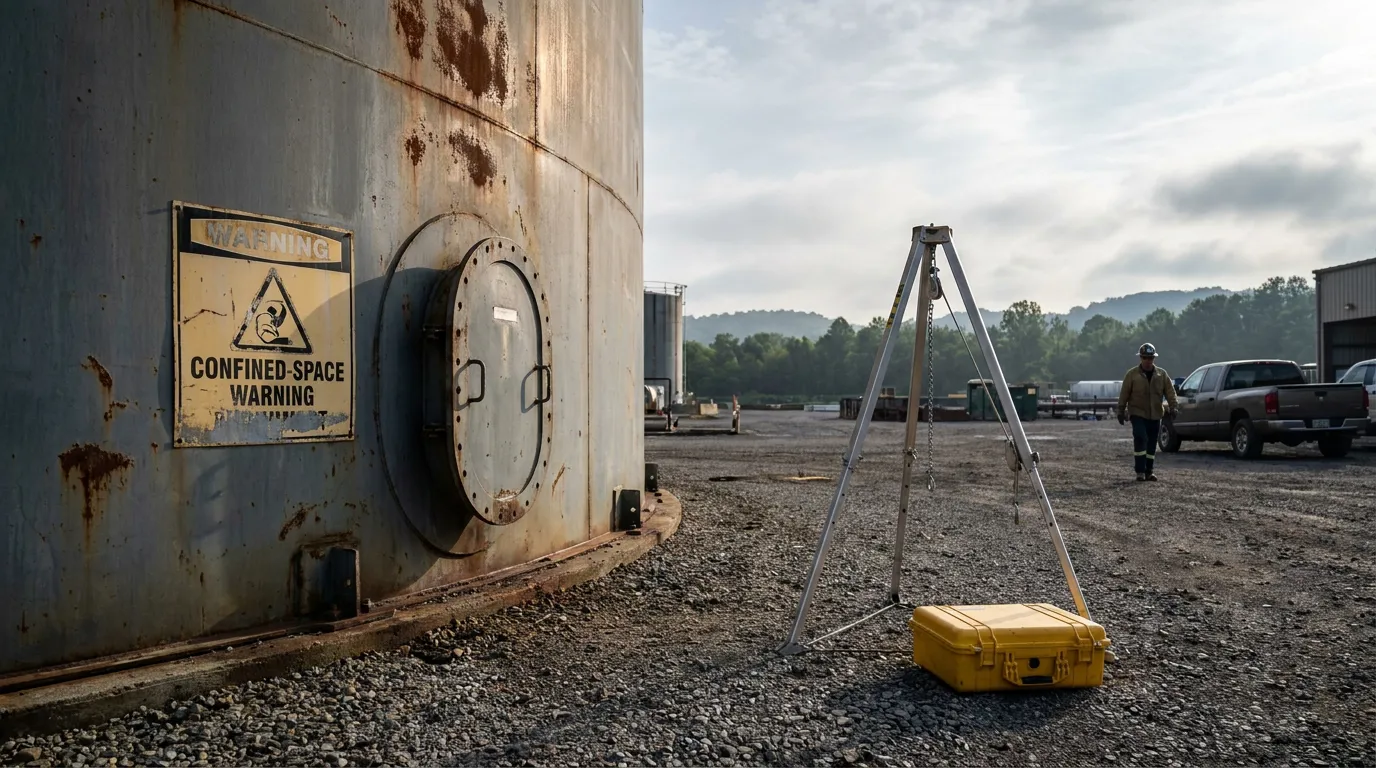
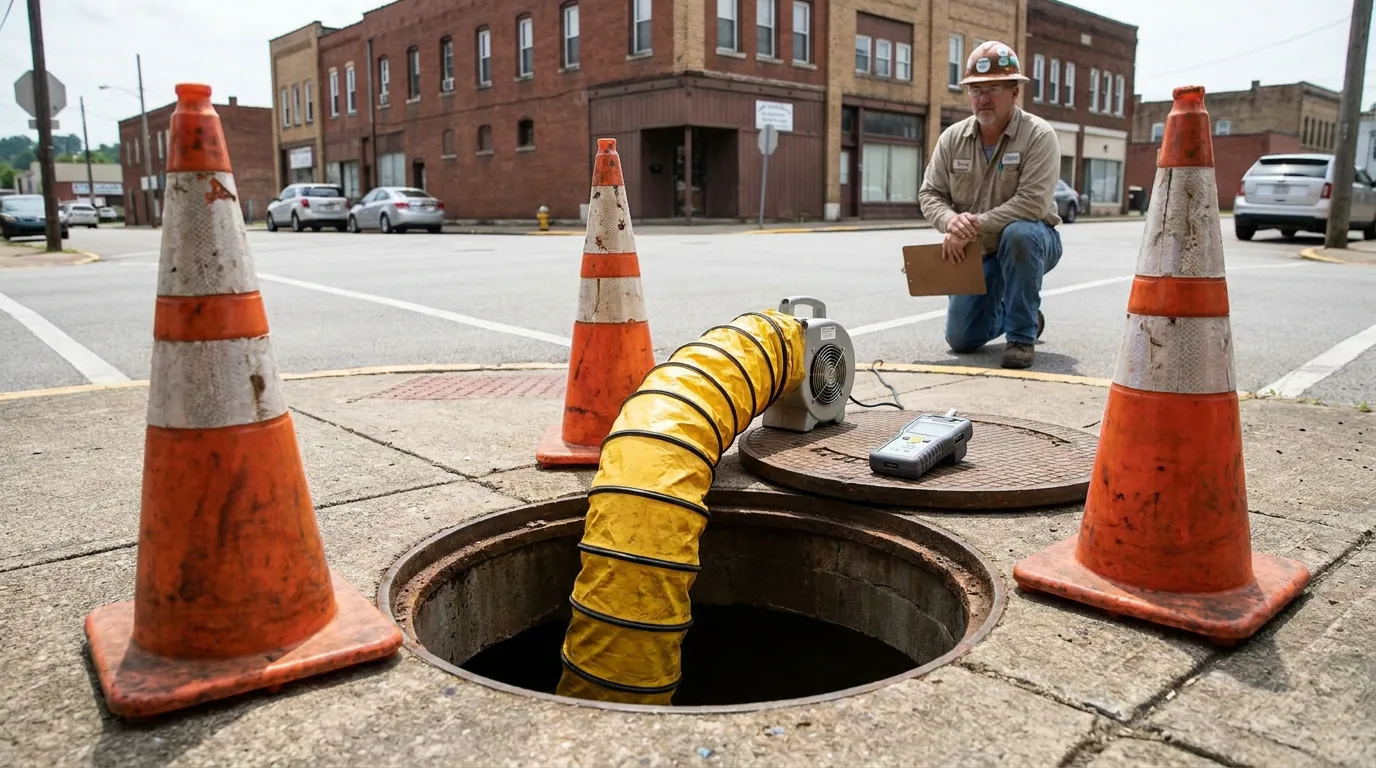
Common examples are storage tanks, silos, manholes, utility vaults, pits, hoppers, and pipelines. These spaces often have poor natural airflow, which lets toxic gases build up or oxygen drop to dangerous levels without anyone noticing.
What Makes a Confined Space "Permit-Required"
A confined space becomes permit-required when it has, or could have, at least one serious hazard listed in 29 C.F.R. § 1910.146(b). The regulation names four hazard types:
| Hazard Category | What It Means | Example |
|---|---|---|
| Hazardous atmosphere | Contains or may contain toxic, flammable, or oxygen-deficient air | Hydrogen sulfide in a sewer vault |
| Engulfment | Liquid or loose, flowable material could bury or surround the entrant | Grain, sand, or coal in a bin |
| Entrapping configuration | Inward-sloping walls or tapered floors could trap or asphyxiate | A hopper narrowing to a small outlet |
| Other serious hazards | Any recognized serious safety or health hazard | Unguarded moving parts, live electrical lines, extreme heat |
Whether a space qualifies depends on the facts, and one space can change category as conditions change. For example, a tank that is safe when empty could become permit-required once cleaning chemicals go in. OSHA’s guide to permit-required confined spaces explains these categories and the employer duties that come with them.
How OSHA 1910.146 Applies in Morgantown and Across West Virginia
Federal OSHA generally enforces the confined space standard directly in West Virginia. West Virginia does not run its own OSHA-approved state plan, so federal regulations generally set the main safety rules for private employers in Morgantown, Monongalia County, and the rest of the state. State and local government employers are not covered by federal OSHA. Some industries follow separate rules. For example, mines generally fall under the Mine Safety and Health Administration, and construction work has its own confined space rule at 29 C.F.R. Part 1926, Subpart AA.
The general industry permit-space rule was finalized in 1993. Before that, OSHA often relied on interpretation letters and the General Duty Clause, 29 U.S.C. § 654(a)(1), to address confined space dangers.
Employer Duties Before Anyone Enters
Under 29 C.F.R. § 1910.146(c)(1)-(2), employers generally must check their workplaces for permit spaces and tell employees where those spaces are and what dangers they pose. This is often done with danger signs posted near entry points. If workers will not enter, the employer generally must take effective steps to keep them out.
If entry is needed, 29 C.F.R. § 1910.146(d) generally requires a written permit space program. That program generally must cover atmospheric testing and monitoring, hazard controls, ventilation, equipment, attendants stationed outside, and rescue procedures. In most cases, a written entry permit listing the hazards, test results, and authorized workers must be completed before entry. Limited exceptions exist, such as alternate procedures when ventilation alone controls the only hazard.
💡 Pro Tip: If you were hurt inside a confined space, write down the names of everyone who was there, including any attendant or supervisor. Note whether anyone tested the air or filled out a permit.
Why a Confined Space Accident Injury Is So Often Catastrophic
Confined space incidents tend to cause severe injuries or deaths because the dangers are often invisible and escape is hard. Investigations by the National Institute for Occupational Safety and Health (NIOSH) have documented many deaths caused by oxygen deficiency, toxic gases, and engulfment. A troubling pattern appears again and again: many victims are coworkers who rushed in to help without protection and were overcome themselves.
Survivors may live with life-changing harm. Oxygen deprivation can cause permanent brain damage. Engulfment and entrapment can cause crush injuries, fractures, and suffocation-related complications. Toxic chemicals can cause burns or long-term lung disease. These injuries can mean emergency surgery, long hospital stays, and years of medical care.
Common Safety Failures Behind These Incidents
Many confined space tragedies come back to skipped steps in the permit process. An investigation may look at whether the employer failed to test the air, provided no ventilation or respirators, skipped training, left no attendant outside, or had no real rescue plan. Entry permits, monitoring logs, and training files can become important evidence. OSHA generally requires employers to keep canceled permits for only one year, so preserving records early can make a difference.
Your Legal Options After a West Virginia Confined Space Injury
Most injured workers in West Virginia start with workers’ compensation, but that may not be the only option. Workers’ compensation generally pays medical bills and part of lost wages no matter who was at fault. In return, it usually shields covered employers from lawsuits under W. Va. Code § 23-2-6. Under W. Va. Code § 23-4-15, the deadline for an injury claim is generally six months from the injury. Occupational disease claims follow different deadlines.
Deliberate Intent Claims Under W. Va. Code § 23-4-2(d)(2)
West Virginia’s "deliberate intent" law may let an injured worker sue an employer directly in narrow circumstances. Under W. Va. Code § 23-4-2(d)(2)(B), the worker generally must prove five things. First, a specific unsafe working condition posed a high degree of risk and a strong probability of serious injury or death. Second, the employer actually knew about the condition and its risk. Third, the condition violated a safety statute, rule, or regulation, or a commonly accepted industry safety standard. Fourth, the employer still intentionally exposed the worker to it. Fifth, serious compensable injury or death directly resulted. A violation of OSHA 1910.146 could support part of such a claim, depending on the facts. Reporting on West Virginia deliberate intent cases shows how hard these claims can be to prove, and they are not guaranteed.
Third-party claims may also be possible. If a contractor, equipment manufacturer, or property owner other than your employer contributed to the incident, you may be able to bring a negligence or product liability claim against that party. However, the workers’ compensation carrier may have a right to be repaid from a third-party recovery. Personal injury claims in West Virginia are generally subject to a two-year statute of limitations under W. Va. Code § 55-2-12, and wrongful death claims generally must be filed within two years of the death.
Damages That May Be Available in Serious Cases
Depending on the type of claim, an injured worker may be able to seek compensation for:
- Emergency care, hospitalization, surgery, rehabilitation, and future medical treatment
- Lost wages and reduced ability to earn in the future
- Pain and suffering, emotional distress, and loss of enjoyment of life
- Wrongful death damages for surviving family members under W. Va. Code § 55-7-6
Workers’ compensation benefits generally do not include pain and suffering, but deliberate intent and third-party claims may, subject to statutory limits and offsets. A Morgantown work injury attorney can help document both the financial and personal costs of a confined space accident injury.
Frequently Asked Questions
1. Is every tank or crawl space a permit-required confined space?
No. A space must first meet OSHA’s confined space definition. It then generally needs at least one listed hazard to be permit-required.
2. Does OSHA’s standard apply to my West Virginia employer?
In many cases, yes. West Virginia private employers generally fall under federal OSHA. Construction, mining, and some other industries may be covered by different rules, and public employers are not covered.
3. Can I sue my employer if they ignored confined space rules?
Possibly, under the deliberate intent statute. These claims require proof of the employer’s actual knowledge and several other elements.
4. What if a rescuer was hurt trying to save me or a coworker?
Injured rescuers may have their own claims. Whether they have workers’ compensation, deliberate intent, or third-party claims depends on their employment status and the circumstances.
5. How long do I have to act?
The deadlines differ by claim type. Workers’ compensation injury claims generally must be filed within six months, and most civil claims within two years.
Protecting Your Future After a Confined Space Tragedy
OSHA 1910.146 exists because confined spaces can kill or permanently disable workers within minutes. If your employer or a third party skipped required testing, ventilation, training, or rescue planning, you may have options beyond standard workers’ compensation. To learn more about workplace injury rights in West Virginia, you can explore our legal resources. Every case depends on its specific facts.
If a confined space incident has changed your life, the team at Robinette Legal Group PLLC can review your situation. Reach out to the team at Robinette Legal Group PLLC by calling 304-501-5753, or request a case review to talk about your next steps.
Disclaimer: This content is for informational purposes only and is not legal advice. Every case is unique, and results may vary. Consult an attorney about your specific circumstances.

Jeffery Robinette was admitted to practice law in 1991 and is licensed in all levels of state and federal trial courts in West Virginia. Mr. Robinette is also licensed in all state and federal appeals courts in West Virginia and the United States Supreme Court. As a National Board Certified Trial Attorney who has handled hundreds of motor vehicle, injury, and construction defect claims and a leading author on insurance claims settlement issues and difficulties in West Virginia, Jeff Robinette is uniquely qualified to represent your best interest.